Wet Spots in the Lawn: Sprinkler Leak or Main Line Leak?
A soggy patch in the yard is usually a sprinkler leak, but sometimes it's the main line. Here's how Spring homeowners tell the difference before the damage spreads.
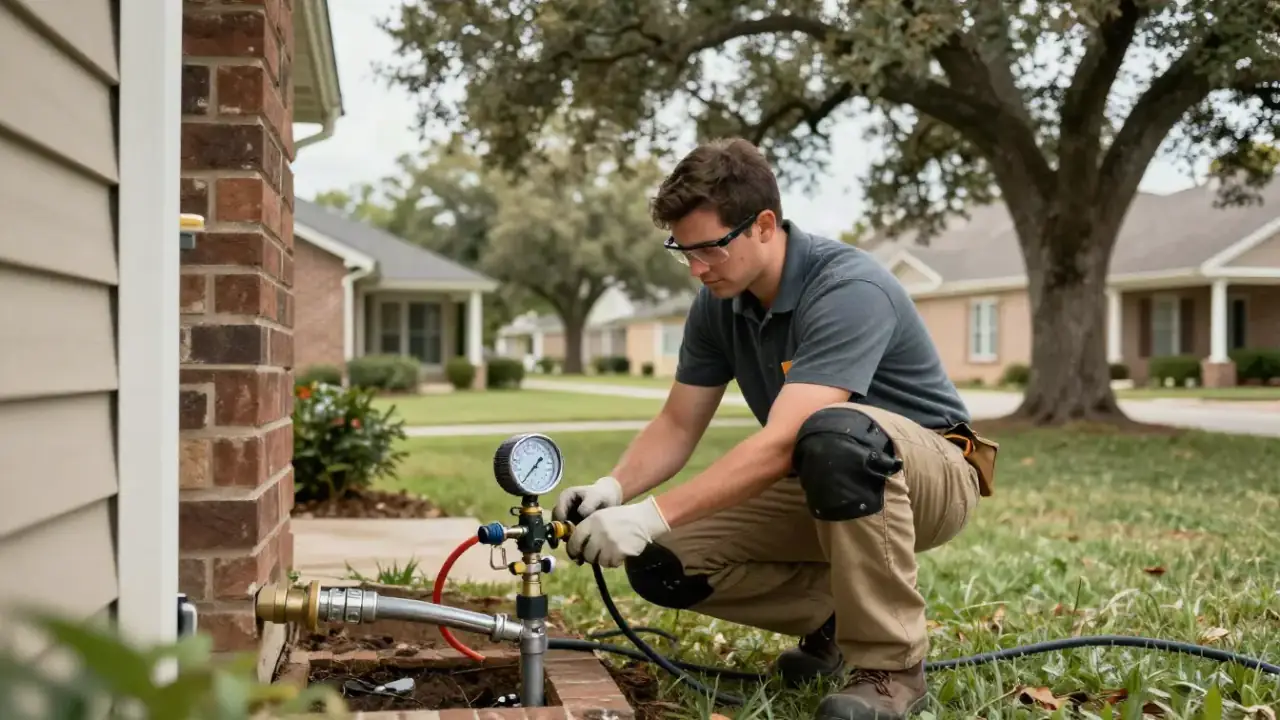
A wet spot in the lawn is usually a sprinkler leak, but it is a main line leak when the water meter keeps spinning with every irrigation zone shut off. That single test - meter on, sprinklers off - separates the two problems in about twenty minutes, and it is the first thing we run on every call in Spring. The rest of this post walks through the symptoms, the soil and slab conditions we see in this part of Harris and Montgomery County, and what it costs to fix each type of leak in 2026.
The Quick Answer: Sprinkler Leak vs Main Line Leak
Wet spots in lawn sprinkler or main line leak Spring TX diagnosis comes down to one question: does the water stop when the irrigation system is off? If yes, you have a sprinkler problem. If the puddle keeps growing overnight with the system off, the leak is on the pressurized service line running from the meter to your house.
Here is the short version we give homeowners on the phone:
- Sprinkler leak: wet spot appears only after a zone runs, usually near a head or valve box, and the meter stops spinning when the controller is off.
- Main line leak: wet spot is wet 24/7, often in a straight line between the meter and the foundation, and the meter keeps ticking even with every zone off.
- Slab or under-house leak: wet spot is against the foundation or in the crawl space, not out in the middle of the yard.
If you want a second opinion before you dig, our team handles Leak Detection Spring TX calls every week and can usually tell you which side of the meter the leak is on before we arrive.
What Causes Wet Spots in the Lawn in Spring, Texas?
Wet spots in the yard leak Spring homeowners call about almost always trace back to one of five sources: a broken sprinkler head, a cracked lateral line, a failed valve, a pinhole in the copper or PVC service line, or a slab leak pushing water up through the soil.
Spring sits on a mix of clay-heavy soil and sandy loam depending on which side of I-45 you are on. Clay holds water and spreads a wet spot into a wide, shallow bog. Sand drains fast and hides a leak until the ground collapses. That difference matters because a main line leak under clay can run for weeks before you notice it, while the same leak under sand shows up as a sinkhole in days.
Three local patterns we see over and over:
- August through October heat. Clay soil shrinks, shifts, and shears sprinkler laterals at the fittings. Most of our sprinkler leak calls land in this window.
- Freeze events. A hard freeze cracks backflow assemblies and exposed PVC. The leak shows up when you first run the system in spring.
- Age of the service line. Homes built in the 1970s and 1980s around Old Town Spring and Timberlane often still have original copper service lines that are now pinhole-prone.
If your wet spot sits in a neighborhood with a lot of mature landscaping and original pipe, it is worth having us look at it before you assume it is just irrigation. Homeowners in Leak Detection in Old Town Spring deal with this constantly because so many of those lots still run on 40-year-old service lines.
How to Tell If the Wet Spot Is a Sprinkler Leak
A sprinkler leak is the most common cause of a wet spot in a Spring lawn, and it almost always leaves three clues: the spot is localized, it appears after a zone runs, and the water meter stops when the controller is off.
Walk the yard after a zone finishes and look for these signs:
- A soft, spongy circle 2 to 6 feet across, usually downhill from a head.
- A head that is pushed up out of the ground or sitting lower than its neighbors.
- Water bubbling at a valve box lid, or a valve box that stays full between cycles.
- One zone that runs noticeably lower pressure than the others.
- A green stripe of grass that stays greener than the rest of the lawn in a drought.
Most sprinkler lateral breaks happen at the 90-degree elbows and the head risers, not in the middle of a straight run. That is why the wet spot is usually within a few feet of a head. If you find a geyser when a zone kicks on, you have your answer - that is a broken riser or a sheared lateral, and our Irrigation and Sprinkler Leak Repair Spring TX crew fixes those same-day in most cases.
Typical 2026 pricing in this area runs $150 to $350 for a single head or lateral repair, and $400 to $900 if we have to replace a valve or a section of mainline irrigation pipe.
How to Tell If the Wet Spot Is a Main Line Leak
A main line leak is the one you cannot ignore. It sits on the pressurized line between the water meter at the curb and the shutoff at your house, and it runs 24 hours a day until someone stops it.
The tell is simple: the wet spot does not dry out, even on a 95-degree afternoon with the sprinklers off. You may also notice:
- The water meter's low-flow indicator (the little triangle or dial) spinning with every fixture and every irrigation zone off.
- A water bill that jumped 20% to 60% month over month with no change in habits.
- Lower water pressure at the far end of the house, especially the master shower.
- A wet spot that follows a straight line from the meter toward the house.
- Soil that feels like a sponge even after a dry week.
A main line leak under a Spring driveway or sidewalk can run for months before it surfaces. That is why we start every main line call with a Water Meter Leak Diagnosis Spring TX - the meter tells us whether the loss is on the service line, in the irrigation system, or inside the house, and it takes about 20 minutes.
Repair costs on a service line in 2026 typically land between $900 and $2,800 depending on depth, surface (grass vs. concrete), and whether we can spot-repair or have to replace a full run. A high water bill alone can run $80 to $200 a month in wasted water, so most homeowners break even on the repair within the first year.
The 20-Minute Test That Narrows It Down
You can separate a sprinkler leak from a main line leak at the meter in about 20 minutes with no tools beyond a flathead screwdriver.
- Shut off every fixture in the house - no faucets, no toilets running, no ice maker filling.
- Turn the irrigation controller to OFF, not just to a rain delay.
- Find your water meter box at the curb and lift the lid.
- Watch the low-flow indicator for 60 seconds. If it is still, you have no pressurized leak.
- If it is spinning, turn the main shutoff at the house to OFF. If the meter stops, the leak is on the service line between the meter and the house. If it keeps spinning, the leak is between the meter and the city main - call the city.
- If the meter was still with everything off, run one irrigation zone for 5 minutes, then shut it off and watch the meter again. A spinning meter after a zone runs points to a sprinkler leak.
That test is free and it tells you which contractor to call. If the meter is still and the wet spot only shows up after irrigation, you need a sprinkler tech. If the meter is spinning with everything off, you need a leak detection company that handles Water Service Line Repair Spring TX.
Common Mistakes Spring Homeowners Make
The most expensive mistake we see is assuming every wet spot is irrigation and letting a main line leak run for another month. The second is digging before you test.
Watch out for these:
- Digging at the wet spot first. Water travels along the trench backfill. The wet spot is often 10 to 20 feet from the actual break.
- Turning the controller to "rain delay" instead of OFF. Rain delay still allows a cycle. The meter test only works with the controller fully off.
- Ignoring a slow meter spin. A pinhole leak the size of a pencil tip wastes 6,000 to 10,000 gallons a month. That is real money.
- Assuming the city covers the service line. In Spring, the city owns the meter and the main. Everything from the meter to your house is yours.
- Replacing the whole system when one valve failed. A stuck valve is a $250 to $500 fix, not a $4,000 rebuild.
If you are not sure which side of the meter you are on, a quick High Water Bill Investigation Spring TX will tell you where the water is going before you spend a dollar on digging.
When to Call a Professional
Call a leak detection professional when the meter spins with everything off, when a wet spot does not dry out after 48 hours with the irrigation off, or when you see water against the foundation or in the crawl space.
Those three signs point to a pressurized leak, and pressurized leaks do not heal. They undermine soil, crack slabs, and rot framing. Our team at Spring Leak Detection uses acoustic listening, thermal imaging, and pressure isolation to pinpoint the break before we dig, so we open one hole instead of five. We find the leak, fix it, and test the line before we leave.
If you are in one of the newer master-planned neighborhoods and your wet spot sits between the meter and the house, we handle Leak Detection in Gleannloch Farms and the surrounding communities with the same process - locate first, then repair.
Frequently Asked Questions
How do I know if my wet lawn is a sprinkler leak or main line leak in Spring TX?
Turn off every fixture and the irrigation controller, then watch the water meter's low-flow indicator for 60 seconds. If it spins, you have a main line or service line leak. If it stays still and the wet spot only appears after a zone runs, it is a sprinkler leak.
What causes wet spots in the lawn in Spring, Texas?
Five causes cover 95% of the calls we run: a broken sprinkler head or riser, a cracked lateral line, a failed zone valve, a pinhole in the copper or PVC service line, or a slab leak pushing water up through the soil. Clay soil in Spring spreads the wet spot wide, so the visible puddle is rarely the break.
Can a main line leak cause wet spots in my yard in Spring TX?
Yes, and it is the more serious of the two. A main line leak runs 24/7 on the pressurized line between the meter and your house, so the wet spot never dries out. You will usually also see a 20% to 60% jump in the water bill and lower pressure at the far end of the house.
Who can find lawn leaks in Spring TX?
Spring Leak Detection locates and repairs both sprinkler and main line leaks across Spring, including Old Town Spring, Gleannloch Farms, Champion Forest, and The Woodlands. We use acoustic and thermal tools to pinpoint the break before we dig, and we test the line after the repair.
How much does lawn leak detection cost in Spring TX in 2026?
Most residential leak detection runs $250 to $450 in 2026 and is often credited toward the repair. Sprinkler repairs typically run $150 to $350, and service line repairs run $900 to $2,800 depending on depth and surface.
Get Help with Leak Detection in Spring
If your lawn has a wet spot that will not dry out, we can tell you in one visit whether it is a sprinkler leak or a main line leak - and fix it the same day in most cases. Call Spring Leak Detection at (281) 248-8538 and we will get a technician out to your yard.